







Tachograph compliance: a practical guide for fleet managers
Published 16/06/26 | Read time 12 min
Tachograph compliance: a practical guide for fleet managers
Published 16/06/26 | Read time 12 min
Tachograph compliance is one of the most complex areas of fleet management to get right. The legal framework is detailed, the enforcement consequences are serious, and yet many of the failures encountered at Public Inquiry come down to predictable, avoidable process gaps.
This guide sets out the practices that distinguish well-run fleets from those that find themselves in front of a Traffic Commissioner explaining why their systems didn't catch what the data was telling them.
Understanding the two parallel regimes
The first principle of tachograph best practice is recognising that drivers operate under two separate sets of rules running in parallel:
- Assimilated EU Drivers' Hours Rules (Regulation (EC) 561/2006): Govern driving time, breaks, and rest.
- The Road Transport (Working Time) Regulations 2005 (WTD): Govern total working time.
They overlap in the tachograph record, but they are enforced differently and they fail differently.
Drivers' hours rules are enforced by the Driver and Vehicle Standards Agency (DVSA) at the roadside and through operator visits.
Conversely, the Road Transport Directive working time provisions are enforced by the Health and Safety Executive (HSE) – a distinction that catches many transport managers off guard.
In practice, prosecutions for WTD breaches are rare, but the data sits in your tachograph records regardless. The moment a serious incident occurs, every record becomes evidence. A fleet that has quietly been breaching the 48-hour average for two years will find that out in the worst possible circumstances.
Working time infringements are common, including both the headline 48-hour average and the six-hour Working Time break rule – a 30-minute break required once six hours of working time have accumulated, with that requirement increasing to 45 minutes once total work passes nine hours.
Drivers and planners often treat their EU 561 break (45 minutes after 4.5 hours of driving) as sufficient cover. However, a driver doing four hours of driving and three hours of "Other Work" hits the six-hour WTD threshold before an EU 561 break is legally due.
Managers should also remember that, under UK enforcement, a Period of Availability (POA) is neither a break under EU 561 nor working time under the WTD – it sits as its own activity category, distinct from both. Drivers operating into the EU need to be aware that some member states do treat POA as break time under EU 561, but relying on that interpretation at a UK roadside check will not work.
Best-practice tacho analysis flags these gaps separately and routinely.
Tacho download cadence and the case for remote downloading
The legal minimums are well known: driver cards every 28 days and vehicle units every 90 days. The retention requirement is straightforward: every operator must hold at least a full year of driver hours records, available for inspection on request. Treating these figures as targets rather than ceilings is the first signal of a fleet not actively managing its data.
Best practice is to download driver cards every 21 days and vehicle units every 60 days. This creates a buffer against legal limits and a margin of safety against missed downloads due to holidays or sickness.
However, the most meaningful operational shift in recent years has been the move away from manual downloads entirely. Remote downloading captures tachograph data automatically while vehicles are on the road, often daily, eliminating compliance bottlenecks.
The case for remote downloading is operational as well as compliance-driven:
- Manual downloads consume up to 40 minutes per vehicle once someone has located the vehicle, connected equipment, completed the download, and filed it correctly.
- For every 10 vehicles operated, that equates to around 7 hours of operational time a month producing no value. For every 100 vehicles, that’s around 70 hours.
- Most importantly, the delay between a driver returning to base and a manager seeing an infringement means it’s often too late to effectively investigate. When data is captured and analysed daily, the conversation with the driver happens while events are fresh, the planning context is recoverable, and corrective action carries weight.
Getting manual entries right
Following the Mobility Package changes that came into force in the UK from 2022 onwards, manual entries are now one of the most heavily examined aspects of any roadside stop.
The carrying obligation is rolling: every driver must have today's records plus those of the preceding 28 calendar days available for inspection at all times, with that obligation running continuously across weekends, annual leave and sick days alike.
On reinserting a card after time away from a vehicle, drivers should step through the device prompts and log everything that has happened in the gap – overnight rest, weekly rest, annual leave, sickness, or time spent on non-driving work.
Two pitfalls catch drivers out repeatedly: the entry sequence runs only on first insertion (an accidental ejection ends the chance to capture those missing periods), and the prompt times out after roughly a minute of inactivity.
Getting time and date right also matters, particularly across the British Summer Time and UTC switchover.
For staff who drive only occasionally, such as a workshop fitter moving vehicles between bays, an engineer taking a unit to an MOT, or a supervisor moving a tractor around the yard, completing a full digital entry for every short trip is impractical. In these cases, written manual records on a tachograph printout, annotated with the driver’s name and licence or card number, are an acceptable alternative.
For weeks containing no in-scope driving at all, the cleanest practice is a single digital manual entry covering the whole block.
Drivers who occasionally cross into the EU should note that continental enforcement is stricter on this point: longer non-driving periods should be logged on the card itself or backed by a formal attestation, because loose paper printouts frequently fall short of what EU officers expect to see at the roadside.
Working time agreements and declarations of other work
A properly executed workforce agreement unlocks three useful flexibilities. The standard 17-week reference period for calculating the 48-hour weekly average can be stretched out to 26 weeks. That reference period can be locked to defined calendar blocks rather than rolled forward week by week. And the 10-hour ceiling on night work can be lifted in agreed circumstances.
The agreement itself can be either a collective agreement struck with an independent trade union or a workforce agreement reached with elected employee representatives and, in workforces of 20 or fewer, a direct majority sign-off is enough in place of formal election.
The procedural detail matters, however. The vote must be by secret ballot, the document must be in writing, and the term cannot run beyond five years before renewal. An agreement that misses any of these steps is legally void, and any reliance on its extended reference period collapses with it.
One important point can catch out managers moving in from other sectors: mobile workers under the Road Transport Directive cannot sign an individual opt-out from the 48-hour average. The familiar opt-out form that applies under the standard Working Time Regulations 1998 has no force here.
The second piece of paperwork – the declaration of other work – exists because working time is measured across every job a driver holds, not just the operator's own. If a driver moonlights as an agency driver elsewhere, picks up bar shifts at weekends, or runs another business in their off-hours, those hours feed into the same 48-hour calculation. Without a written declaration capturing that, the operator has no way of knowing whether they're compliant.
Best practice is a signed declaration at induction, refreshed annually, with drivers under a clear obligation to report any change immediately.
Triaging infringements and OCRS impact
Tachograph analysis software produces a high volume of alerts. Without a structured triage approach, managers either drown in data or stop reading it altogether. Best practice requires categorising by severity.
Most Serious Infringements (MSIs)
MSIs are the most serious category of compliance breach, defined in Annex IV of Directive 2006/22/EC. Examples include:
- Driving more than a quarter beyond the six-day or fortnightly maximum
- Running 50% or more over the daily driving cap without a qualifying break or 4.5-hour interrupted rest
- Driving without a card, with someone else's card, or with a card that has been altered or fraudulently obtained
- Operating with a tachograph or speed limiter that is missing, disabled, or fitted with a device designed to manipulate the recording
OCRS is split into two categories: a Traffic score (covering drivers' hours, tachograph offences, and weighing/overloading checks) and a Roadworthiness score (covering vehicle defects, maintenance issues, and annual test history).
MSIs hit the Traffic score directly, while vehicle defects affect Roadworthiness. Accumulating serious points in either category will rapidly push an operator into a "Red" high-risk status. MSIs require same-day investigation.
Very Serious Infringements (VSIs) & Serious Infringements (SIs)
- VSIs: Cover severe rest deficiencies (such as falling short of daily or weekly rest by a large margin) or exceeding the 56-hour driving week. These require investigation within 48 hours and a documented debrief within five working days.
- SIs & Minor Infringements: Cover minor overruns and late breaks. These should be reviewed weekly, focusing on systemic patterns rather than isolated events.
The disciplinary process: Balancing employment law and compliance
Where infringements suggest poor performance, the disciplinary process matters as much as the technical finding. The ACAS Code of Practice on disciplinary and grievance procedures sets the framework. Issues should be raised promptly, and investigations must be thorough and open-minded. What looks like driver error may turn out to be poor training, an unrealistic schedule, or a planning failure.
Employees must be informed of the case against them in writing, given time to prepare, allowed to be accompanied at formal meetings, and granted a right of appeal.
Notifying the Traffic Commissioner
Operator licence holders sign an undertaking to notify the Traffic Commissioner of any relevant convictions or fixed penalties. This covers drivers' hours, tachograph offences, overloading, speed, weight offences, and operator licensing itself. When notifying, explain the incident, the investigation, the findings, and the corrective actions implemented, providing supporting evidence to strengthen the response.
Training and capability
Statutory Driver CPC requirements apply to drivers (35 hours of periodic training every five years), and nominated transport managers must complete CPC refresher training on a five-year cycle. Best practice extends well beyond this statutory minimum. Regular toolbox talks based on live fleet data, attendance at industry conferences, and subscription to compliance updates keep systems sharp. External compliance audits every 12 to 18 months provide an objective view that catches hidden risks.
How technology can help
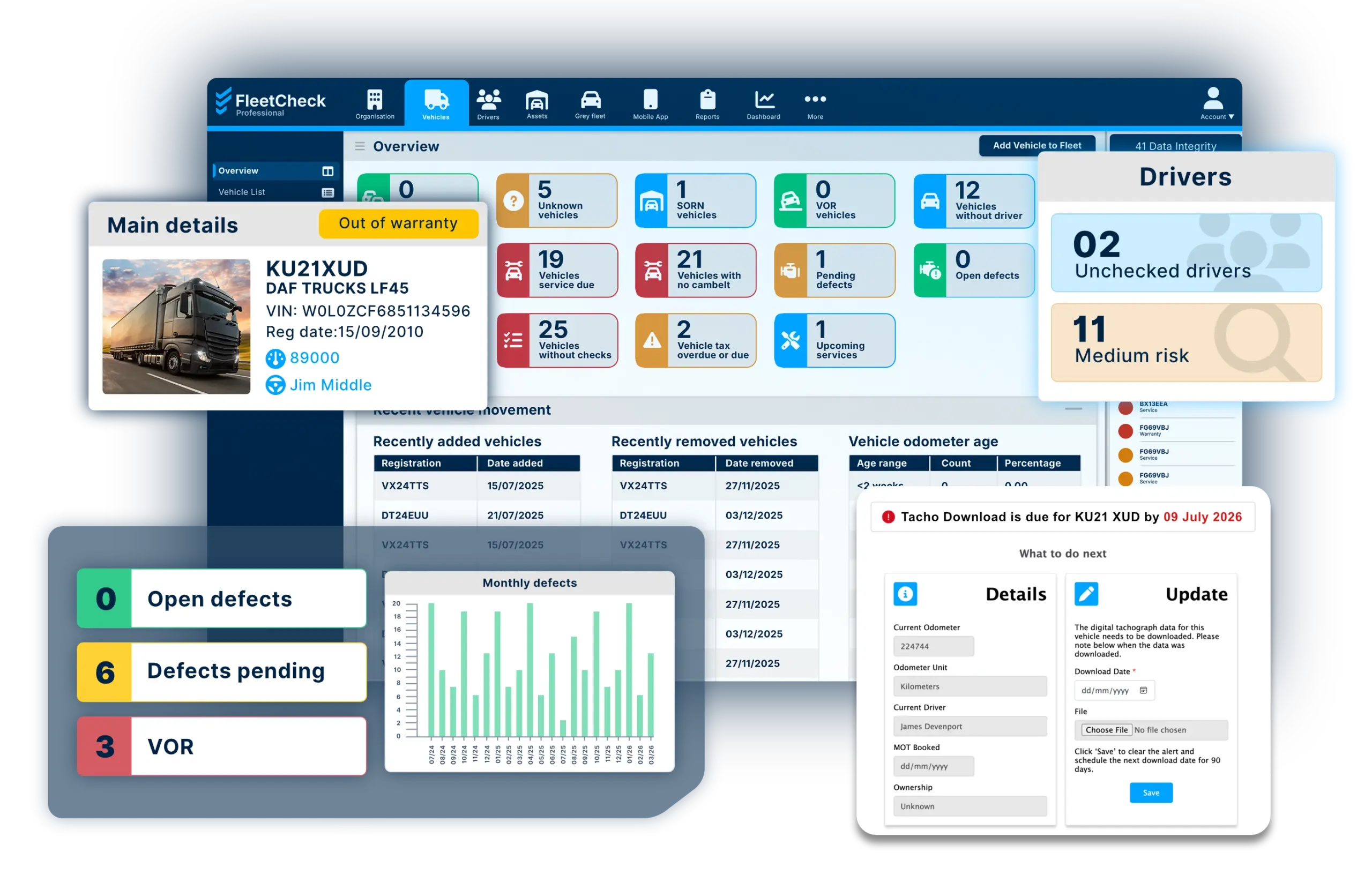
The right technology stack turns tacho management from a reactive task into a proactive workflow. Remote downloading captures data automatically on the road, removing manual admin drag. Modern analysis platforms then process that data against drivers' hours rules, working time provisions, and operator-defined thresholds, flagging issues for human review rather than auto-generating untouched paperwork.
The best systems pull tacho analysis, infringement workflows, calibration tracking, and driver licence checks into a single fleet management view. This ensures the compliance picture sits directly alongside the operational picture. The aim isn't to replace the transport manager; it is to give them their time back to manage effectively.
A practical framework for improvement
For operators looking to implement good practice tacho management, this framework sets out concrete actions in priority order:

Tighten your download cadence:
Target driver cards every 21 days and vehicle units every 60 days using automated alerts. Spot-check download integrity monthly to catch corrupted files early.
Move to remote downloads:
Shift data capture from a periodic task to a continuous one. Operational time savings typically pay for the hardware within months, and the compliance value of investigating an infringement within 24 hours is immense.
Name a single accountable owner:
Designate one Transport Manager or Compliance Lead with explicit accountability for tacho compliance. Ensure documented deputy cover exists for holidays and sickness. Senior leadership should sign off on the process annually.
Close the loop with operations:
Feed infringement data back into route planning weekly. If a specific route generates repeated breaches across multiple drivers, the route timing or delivery window is the issue, not the drivers. Log and challenge customer site bottlenecks commercially.
Standardise the driver debrief:
Use a consistent template covering the event, root cause, required changes, and driver acknowledgment. Record planning factors honestly – blaming a driver for an unrealistic schedule will not survive regulatory scrutiny.
Audit your paperwork:
Ensure workforce agreements are executed correctly where extended reference periods are relied upon. Verify that declarations of other work are signed at induction and refreshed annually.
Establish written triage rules:
Investigate MSIs within 24 hours VSIs within 48 hours with a documented debrief within five working days. Review Serious and Minor infringements weekly to conduct pattern analysis. Ensure systems are configured to audit the standard 28-day historical check window (or 56 days for any driver active on international routes).
Build a monthly management review:
Establish a recurring monthly meeting attended by the Transport Manager, operations lead, and a senior director. Review infringement trends, repeat offenders, training gaps, and audit readiness. Retain these minutes for 24 months – they serve as vital evidence during Public Inquiries and Earned Recognition audits.
The cultural foundation
Every part of good tachograph practice depends on a culture that treats compliance as continuous rather than episodic. The fleets that navigate enforcement successfully are not those with pristine data, but those that demonstrate they actively manage what their data tells them. Every infringement is either a learning opportunity or a future exhibit. Best practice is deciding which one it becomes.
Need more help?
Operators can integrate their tacho analysis information directly into their FleetCheck account through our new partnership with VDO. Benefits include:
- Simplified drivers’ hours compliance
- Highlighted missing downloads
- Managed key dates for recalibration
- Safe and compliant fleet management of regulatory requirements
FleetCheck clients also benefit from a 10% discount on tacho download equipment via the VDO online shop.