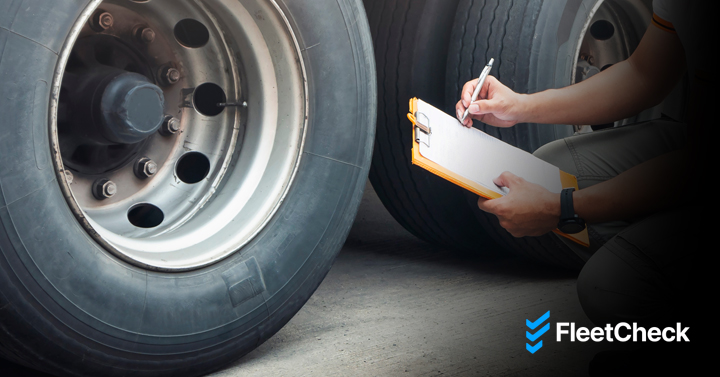
How long should a daily walkaround check take? It's one of the most common questions we hear from fleet operators, and the direct answer is that there is no legally set time. A check should take as long as the driver needs to be satisfied the vehicle is safe. How long it takes depends on the type of vehicle and the work it does, as every fleet has a duty to make sure its vehicles are safe and roadworthy before they go out on the road. Daily walkaround checks are one part of that wider maintenance and safety programme, and for most drivers they are how that gets done.
What the law says
In the HGV world, the daily walkaround check is a defined requirement, set out in the DVSA's Guide to Maintaining Roadworthiness and tied to the Operator's Licence. It is worth being clear that the DVSA's guide does not put a figure on how long a check should take. The DVSA's position is that there is no set time limit. A check should take as long as it needs to take for the driver to be satisfied the vehicle is safe, and rushing it is not acceptable. The time it takes varies with the vehicle. Some HGVs have up to 18 wheels, and checking each one thoroughly can easily account for 15 minutes on its own.
In the LCV and car space, there is no specific law setting out a daily walkaround check in a fixed format, and no prescribed time. What does apply, and applies to every vehicle on the road, is the duty under the Road Traffic Act 1988 to keep the vehicle in a roadworthy condition. On top of that, an employer running vehicles for work has a duty of care under the Health and Safety at Work Act, and a work van counts as work equipment under PUWER, which carries a duty to keep it in good working order. None of those set out a daily walkaround in a fixed format, and none of them put a time on it.
It is worth noting that, although vans below the O-licence threshold sit outside that compliance regime, the DVSA has widened the Guide to Maintaining Roadworthiness so that it now explicitly covers light goods vehicles, not just HGVs and PSVs. For a van, the guide is best-practice advice rather than law, but it gives a clear DVSA reference for what good looks like: regular inspections, proper records, and dealing with defects promptly. So, the legal duty on a van operator is lighter, but the standard the DVSA points to is much the same. And a van is never beyond reach: DVSA can stop any vehicle at the roadside.
What we see in practice
A defect caught in the morning can cost you a recovery call or a day's hire at worst. The same defect caught after a collision, a roadside stop or an HSE investigation costs you vehicle damage, an insurance claim, management time and possibly a prosecution. The pre-use check is the cheapest preventative measure in the box. (Our FleetInsights piece on why daily walkaround inspections are vital to your operations goes through what a thorough check should cover and the importance of creating a defect management process).
Daily checks also protect the driver too, and this is the part that tends to go well when encouraging drivers to carry out daily checks – it’s essentially documented protection. If a driver is involved in an incident and can show the vehicle was checked and sound that morning, that record works in their favour as much as yours. Framed that way, the check stops being a burden imposed from above and starts being in the driver's own interest.
And it is one of the clearest examples of the wider point we make in beyond the bare minimum: why compliance alone isn't enough. Meeting the letter of the law keeps the regulator off your back. It does very little on its own for your downtime, your repair bills or your collision rate. The fleets seeing improvements are the ones treating the daily check as good practice.
Where technology helps with daily checks
An app does not make the physical check any faster necessarily, the check still takes as long as the looking takes. What an app does is take the time and friction out of recording the check and reporting defects in real time to a fleet manager. No longer are you chasing paper check sheets or working retrospectively to fix issues or demonstrate an audit trail.
When a driver completes a check on a phone, the time and date are stamped automatically, photos of any defect can be attached on the spot, and the whole team can see at the start of the day which vehicles have been checked, which have defects, and which drivers have not submitted. A safety-critical defect can flag straight to a manager and stop the vehicle being marked as available until it is cleared. On paper, that same defect sits in the glove box, on the dash, or in the in-tray on someone's desk until they get to it.
For a fleet of any size, that is the difference between knowing where you stand each morning and finding out when a driver calls in from the hard shoulder. FleetCheck Driver includes daily checklists for all vehicle types, real-time defect reporting, and instant notifications of missed checks. The Pro version offers the ability to capture collision data and fuel receipts, share important documents and in-app messaging to drivers.
If you want to talk through how it fits your operation, book a demo or call the team on 01666 575900.