






Driver fatigue is thought to contribute to approximately one in five road collisions, but it rarely leaves evidence and isn’t measured by drivers’ hours rules or tachographs. This article explains what causes fatigue, when drivers are most at risk, what it costs employers, and five practical steps fleets can take to build fatigue into their compliance.
Key takeaways
- Fatigue is thought to contribute to around 20% of road collisions, but it rarely leaves evidence, so it is under-reported
- Alertness drops at predictable times, roughly 02:00-06:00 and 14:00-16:00, whatever a driver’s experience
- 17 hours awake impairs performance about as much as a 0.05% blood alcohol level
- Tachographs measure time, not alertness. A driver can be fully compliant and still be dangerously tired
- Fatigue costs employers money through absence and lost productivity long before any collision happens
- Five practical steps can make fatigue risk visible: education, using existing data, better incident investigation, a no-blame reporting culture, and links to wellbeing programmes
Introduction
Most fleets record collisions, damage and vehicle downtime in some form, even if the records are spread across spreadsheets and HR systems. Fewer record whether fatigue played a part, and fewer still know how much it's costing their organisation.
Research suggests fatigue contributes to approximately 20% of road traffic collisions. Yet unlike speeding, harsh braking, vehicle defects or substance misuse, fatigue often leaves no obvious evidence. It remains largely invisible until something goes wrong.
For fleet operators, this creates a dangerous blind spot.
Driver fatigue is often viewed as a health and safety issue, but it's much broader than that. It affects productivity, absence rates, vehicle damage, insurance costs, recruitment, retention and corporate reputation.
The most successful fleet organisations are beginning to recognise that managing fatigue is not simply about regulatory compliance but managing business risk.
What is driver fatigue?
Let's start with the obvious question… What is fatigue?
Fatigue is a drop in physical or mental performance caused by inadequate sleep, prolonged exertion or disruption to the body's natural sleep-wake cycle.
Numerous studies have explored driver fatigue and its contribution to collisions. For instance, we know that:
- Those driving for work have a higher blameworthiness in collisions with speeding, observational failures and fatigue identified as key contributory factors
- 67% of employers in safety-critical industries reported declines in productivity and 32% experienced safety incidents as a result of fatigue
- 97% of transportation employers feel fatigue is a safety risk, whilst only 72% of employees agreed
Sleep is an obvious factor of fatigue, with many professional drivers not getting enough. Research by Third Pillar of Health for National Highways Commercial Vehicle Incident Prevention team found that:
- Average sleep before work was just 6 hours 37 minutes
- Nearly half of drivers slept less than the recommended seven hours before work
- 78% were not meeting their sleep need across a working week or shift cycle
- 26% were at risk of sleep apnoea and 36% at risk of insomnia
- As a result of fatigue, 65% of drivers reported experiencing sleepiness at work at least a few times each month, while almost one-third (31%) said sleepiness interfered with their work activities.
But fatigue is also influenced by far more than just poor sleep. Seven of the most common risk factors are:
- Quick shift returns (less than 12 hours off)
- Long shifts (over 10 hours)
- Long work weeks (over 50 hours)
- High risk hours (at night or early morning)
- Demanding jobs (either physically or cognitively)
- No (or few) rest breaks during a shift
- Long commutes (over 30 minutes each way)
When are drivers most at risk of fatigue?
Everyone's body clock has two low points, or periods of reduced alertness: roughly 2:00-6:00 and 14:00-16:00. Even your most experienced drivers will be affected. It's this reason why the Highway Code (Rule 91) tells drivers to avoid long journeys between midnight and 6:00.
Our analysis of more than 500,000 reported injury collisions in Great Britain between 2021 and 2025 shows the pattern clearly. Most collisions happen in the rush hours, when traffic is heaviest. But the type of crash most linked to falling asleep at the wheel, a single vehicle leaving a fast road, makes up a far bigger share of collisions in the early hours. For people driving for work, it peaks between 04:00 and 06:00, when it’s three to six times more common than during the working day. There’s also a smaller rise at 14:00, in line with the afternoon dip.
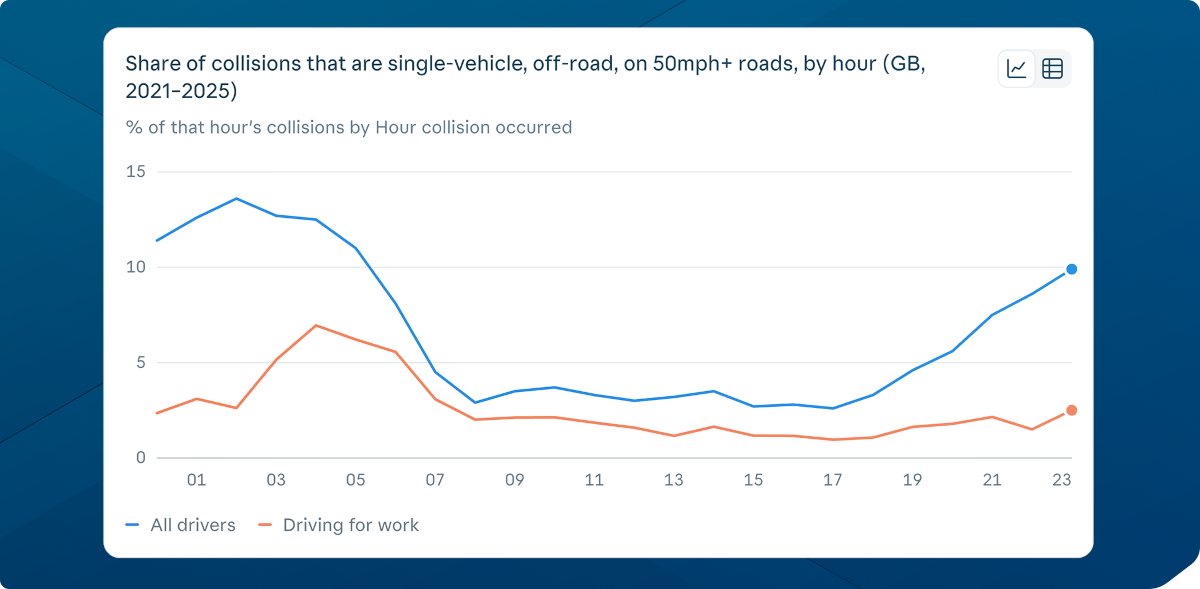
Source: Analysis of Department for Transport STATS19 road safety open data, 2021–2025.
Research has also found that staying awake for a long time can affect drivers in a similar way to alcohol. A study by Dawson and Reid found that after 17 hours awake, people performed about as badly as someone at Scotland's drink-drive limit (0.05% blood alcohol). After 24 hours awake, their performance was equivalent to a blood alcohol level of 0.10%, well above the limit in England and Wales (0.08%).
This is particularly relevant to night-shift operations. Drivers may already have been awake for several hours before a shift begins, meaning that by the end of a long night shift they could be operating with an impairment level comparable to drink-driving limits in many countries.
Why is driver fatigue dangerous?
Fatigue is particularly dangerous because it develops gradually and often remains hidden until an incident occurs.
According to the Health and Safety Executive (HSE) fatigue can lead to:
- Slower reaction times
- Reduced information processing capability
- Reduced attention and vigilance
- Memory lapses
- Poorer judgement and risk perception
- Increased likelihood of errors and accidents
What makes fatigue particularly challenging is that drivers themselves are often poor judges of their own impairment. Many experienced drivers take pride in "pushing through" tiredness, seeing it as part of the job rather than a risk requiring intervention.
How much does driver fatigue cost a fleet?
Most organisations associate fatigue with serious collisions. The reality is that the costs begin much earlier. Fatigue affects concentration, judgement, reaction time and decision-making long before an accident occurs.
According to the National Safety Council’s ‘Employee Cost Calculator for fatigue’ in Production, Transportation and Materials Moving Operations, the annual cost of fatigue per worker is £1,337. This breaks down as £403 for absenteeism, £460 for decreased productivity and £474 for healthcare.
| Average annual cost of fatigue per worker | Annual cost per 100 drivers | |
|---|---|---|
| Absenteeism | £403 | £40,300 |
| Decreased productivity | £460 | £46,000 |
| Healthcare | £474 | £47,400 |
| Annual total | £1,337 | £133,700 |
Even excluding healthcare costs, UK employers lose around £863 per employee annually through absence and productivity impacts alone. For a fleet with 100 drivers, that's more than £86,000 every year before a single collision, claim or prosecution is considered.
This is not a trivial amount and does not even consider additional, often hidden, direct and indirect costs associated with:
- Increased vehicle damage and low-speed collisions
- Higher absence and employee turnover
- Greater insurance and liability exposure
- Management time spent investigating incidents
- Reputational damage following serious events
Other costs that should be considered include:
- Replacement staff costs and sick pay
- Fines and costs of prosecution
- Excess on a claim
- Loss of production or production delays
- Offender’s own legal fees
- Claims from third parties
- Alternative transport for repair duration
- Inconvenience
- Re-delivery
- Staff absence for medical appointments / attendance at court etc.
Is drivers’ hours compliance enough to manage fatigue?
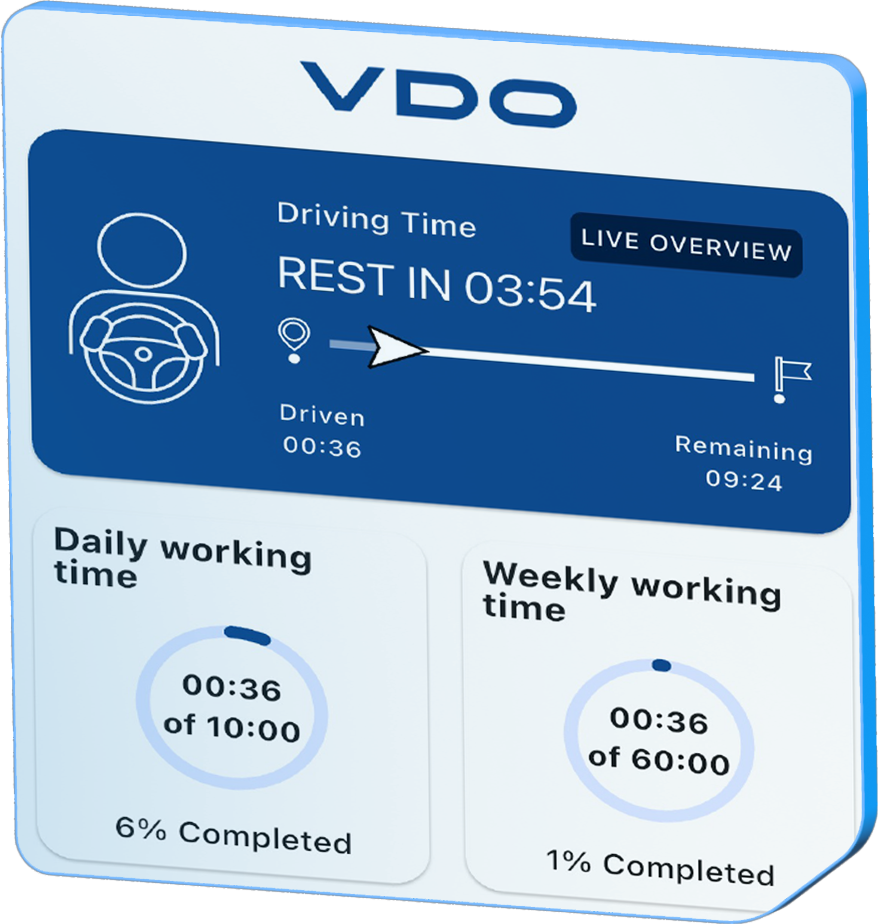
Drivers’ hours rules are essential, but they don't measure fatigue. Tachographs record time, not alertness. They can’t tell you how much sleep a driver got, whether they’ve built up a sleep debt, whether their shift pattern is affecting their recovery or how long their commute is. Ultimately, a driver can be fully compliant and still be too tired to drive safely.
That's why the HSE recommends managing fatigue as a workplace hazard.
The Traffic Commissioners, who regulate HGV and PSV operators, take the same view. In November 2026 they said that effective fatigue management requires more than just monitoring driving hours records and data. Where operators can show they understand and manage these risks, this is taken into account when the Commissioners consider compliance and repute. Equally, repeated failures linked to poor fatigue and welfare controls can lead to regulatory action.
How can fleets manage driver fatigue? (5 steps)
Given the significant direct and indirect costs associated with fatigue, organisations have a strong business case for taking proactive action.
These five steps will help you build it into your compliance:
| Step 1 | Education and awareness | A 2015 Australian study showed crash rates were higher in drivers who had not completed a fatigue management education programme. Educating drivers on spotting signs and factors that might increase fatigue and getting them to see it as a safety risk rather than a personal weakness, is a simple and cost-effective strategy. As is educating managers and giving them the tools to have informed conversations with drivers. |
| Step 2 | Examine the data you already collect | Fleets already collect a wealth of data, which can point to fatigue’s contribution to an accident or incident. The easiest place to start is to examine how many accidents happen in the circadian low points of 02:00-06:00 and 14:00-16:00. Where drivers are working 12-hour night shifts, how many incidents occur in the final two hours of the shift? |
| Step 3 | Gather additional data to make fatigue risk visible | Making fatigue risk visible starts with gathering data for all accidents, incidents and near misses. Use validated fatigue-related questions in every accident and incident investigation. Understand how job-specific, demographic and shift characteristics influence fatigue risk. This exercise allows you to discover patterns in your data and plan around known risk factors. |
| Step 4 | Strengthen company culture | If drivers think reporting tiredness will lead to blame or lost pay, they’ll keep driving and you’ll lose your early warning. The Traffic Commissioners now expect operators to have an open culture where drivers can raise concerns. Make it safe to speak up. Train managers to handle these conversations in confidence. Where you can, have non-driving work ready for drivers who are too tired to drive, so reporting fatigue doesn’t cost them a shift. |
| Step 5 | Integrate into your existing wellbeing or occupational health programme | Sleep health, physical health, mental wellbeing and fatigue are increasingly being managed together rather than as separate issues. You don't need an existing wellbeing programme to start. Why not begin with a sleep health self-assessment for your drivers to understand your overall fatigue risk and which groups are most vulnerable? Apply targeted interventions, then track and monitor results over time. |
What are an employer’s legal duties on driver fatigue?
There is an important distinction between meeting a regulation and meeting a duty of care.
Courts, regulators and investigators frequently consider whether risks were foreseeable and whether reasonable steps were taken to manage them. The HSE's guidance places responsibility on employers to assess and manage fatigue risk as they would any other workplace hazard.
From a legal perspective, organisations that proactively manage fatigue are likely to be in a stronger position should an incident occur. But the case extends beyond legal protection. The strongest organisations recognise that fatigue management is ultimately about protecting people.
Putting drivers on the road comes with a huge amount of responsibility. On the compliance side, you have specific tools to help, such as tachographs for monitoring drivers’ hours. On the human side, quick alertness and cognition tests can help you check how alert someone is before they get behind the wheel.
Conclusion
The challenge for fleet leaders is that fatigue rarely appears as a standalone issue. It hides inside collisions, vehicle damage, absenteeism, productivity losses and staff turnover. Unless organisations actively look for it, they risk measuring the consequences of fatigue rather than the risk itself.
The real question for fleet leaders is not whether fatigue exists in their operation. It is whether they can afford not to make it visible.
Find out more at www.fatigue-risk.com