








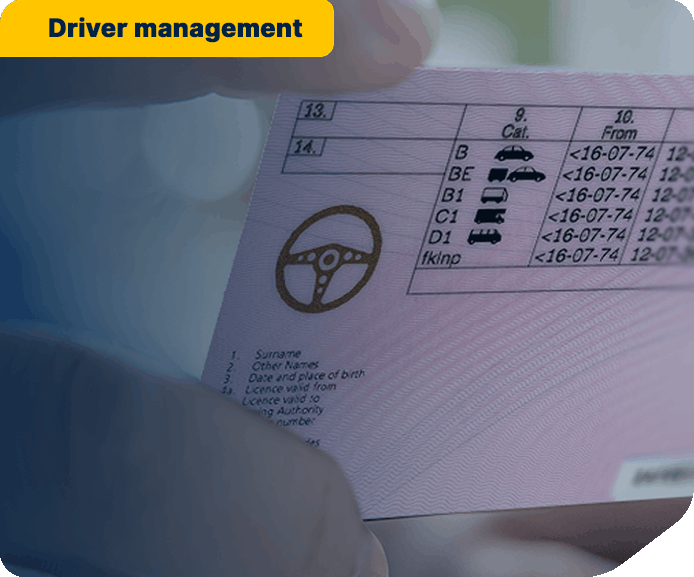
Employers have a legal duty to check that every driver is properly licensed for work, and a photocard sighted at induction doesn’t prove that. It only confirms an entitlement was issued in the past, not current points, restrictions, or medical status. Getting this wrong can invalidate insurance and expose directors to personal liability. This article covers what the law requires, how often to check based on risk, and how to build a process that holds up if something goes wrong.
Summary
- A photocard check only proves a licence was valid at induction. It doesn't show current points, endorsements, restrictions, or medical notifications.
- The legal duty to check driver licences comes from the Road Traffic Act 1988 and the Health and Safety at Work Act 1974, not one single piece of legislation.
- Drivers can legally stay on the road with 12 or more penalty points using the 'exceptional hardship' defence, as shown by the 2013 Baldock case where a driver kept his licence at 54 points.
- Check frequency should be risk-based, ranging from annual checks for clean licences up to monthly checks for high-risk drivers, with O-licence drivers requiring checks every 3 months by law.
- The duty to check licences applies equally to grey fleet drivers using their own vehicles for work, an area often overlooked as someone else's responsibility.
Would you let an unqualified tradesperson into your house?
If someone came to your house to carry out work on your electrics, you would assume their employer had checked that they had the relevant qualifications, wouldn’t you? If they did something wrong that subsequently failed and caused a fire that burnt your house down, endangering you and your family, and destroying possessions with sentimental value, you’d be cross and want action taken against that person. If it then turned out that the electrician wasn’t qualified to do the job in the first place, and that his employer had failed to check whether he was qualified, you’d probably want action taken against the employer wouldn’t you? How dare this company send an unqualified person to your house to do skilled and dangerous work! “Why did they not check if he was qualified?” you would reasonably ask.
Well, just because someone drives to work, or has a car, or appears to have a driving licence – it doesn’t mean they hold a valid licence. It doesn’t tell you whether they have any penalty points. It doesn’t tell you whether their vision is OK. And it doesn’t tell you if they have any medical conditions that could affect their ability to drive.
So, if one of your drivers was involved in a serious incident where another road user was injured, or worse, and it turned out they weren’t correctly licensed for the vehicle they were driving, or not even licensed at all – you could surely understand people questioning why you had failed to do something so basic as checking their driving licence, couldn’t you?
How confident are you that every one of your drivers on the road today is correctly licensed? And, if they are legally able to drive, that they fit within your parameters?
Drivers can be legal with 12 or more points
We all know that if a driver reaches 12 penalty points, they will have their licence taken away for a short period of suspension. What is less commonly known is the defence of ‘excessive hardship’ – which enables a driver to contest the suspension on the grounds that losing their licence would result in excessive hardship by preventing them from conducting vital aspects of their lives. Excuses might include losing their job because public transport isn’t an option, or the need to care for an elderly relative. If the judge or magistrate is persuaded by this argument, the driver may be allowed to continue driving, entirely legally, with 12 or more points on their licence.
Having a high number of penalty points, and certainly more than 12, is going to raise serious concerns with your fleet insurers, if it doesn’t completely invalidate cover for that driver. There is also the problem that someone with so many points presents a clear picture of a driver who doesn’t stick to the Highway Code and therefore, by definition, can’t be following a driving for work policy that says driving to the Highway Code is required. This would expose the employer to significant risk if the driver were involved in an incident.
The Baldock case: 54 points and still driving
To illustrate the point, this case from 2013, featuring a driver called Keith Baldock from Kent, is quite sobering.
Mr Baldock received 30 penalty points in one sentencing – six points each for five separate offences including driving without insurance and failing to pay for fuel. Baldock convinced the judge that he needed his car to look for work and the judge accepted this. What the court failed to do, alarmingly in the context of this article, was check Baldock’s driving licence before sentencing. Had they done so, they would have found he had 24 points and quite probably used the ‘extreme hardship’ defence already. We now have a driver legally on the roads with 54 penalty points!
This doesn’t sound like someone you want working in your business but perhaps the scariest bit is still to come. Baldock was looking for work as a mobile tyre fitter. He was looking for a job that would entail an employer entrusting him with a fully kitted out van, worth in excess of £40k, and allowing him to spend the week driving around the country on their behalf, with their company name on the side of the van, with 54 penalty points.
This might sound excessive but it’s not an isolated case. In January 2015, DVLA revealed in FOIR (Freedom of Information Request) that 48,941 drivers had their licence suspended in the 12 months up to and including December 2014. In January 2016, the IAM (Institute of Advanced Motorists) received a response from DVLA to its own FOIR which showed there were, at that time, over 7,500 people on the roads driving perfectly legally with 12 or more penalty points. A further FOIR response from DVLA in March 2024 showed that over 10,300 drivers had 12 or more points. However, it wasn’t clear from the response how many of those were still legally driving, or whether any were continuing to drive anyway, albeit illegally.
Legislation and guidance on licence checks
The obligation to know that your drivers are properly licensed is not spelled out in a single Act. It emerges from the combined weight of several. Section 87(2) of the Road Traffic Act 1988 makes it an offence to cause or permit another person to drive on a road otherwise than in accordance with a licence authorising them to drive that class of vehicle. The Health and Safety at Work Act 1974 places a general duty on every employer to ensure, so far as is reasonably practicable, the health, safety and welfare of their employees (in this case, drivers) and members of the public (in this case, other road users) – a duty that clearly extends to how you manage business activities that involve driving. The Health and Safety Executive’s guidance says that employers must manage the risks their drivers face and pose, regardless of whether the vehicle belongs to the company or the employee.
The direct financial penalty for a failure could be a fine, but the real exposure sits elsewhere. An incident involving an unlicensed, disqualified or improperly licensed driver can invalidate insurance cover, put the company at risk of serious reputational damage and prosecution, and expose directors to personal liability.
Why a photocard check isn’t enough
A common misconception is that sighting a photocard at induction, perhaps with a photocopy taken for the file, constitutes a licence check. It doesn’t. A photocard confirms an entitlement was issued at a moment in time. It does not reveal points, endorsements, restrictions, medical notifications or any change in status since. A driver who picked up nine points last year looks identical, card in hand, to a driver with a clean record.
Since the paper counterpart was withdrawn in 2015, the only reliable way to establish a driver’s current position is to draw on live DVLA data – either via the driver themselves through the government’s Share Driving Licence service, which generates a one-time code, or through an approved licence checking provider connected to the DVLA’s Access to Driver Data (ADD) channel.
| Method | What it shows | Live DVLA data? | Admin time |
|---|---|---|---|
| Sighting the photocard | That an entitlement was issued at some point in the past | No | Low, but near worthless as evidence |
| Share Driving Licence service | Current entitlements, points, endorsements, restrictions | Yes | High: one-time code needed from every driver for EVERY check |
| Approved provider | Current entitlement, points, endorsements, restrictions, plus automated rechecks | Yes | Low: mandate valid for three years, check run automatically |
Licence conditions
A key part of the licence check is making sure the driver is entitled to drive the class of vehicle they are in. These are called Driving Licence Categories.
Some drivers are only allowed to drive if they or their vehicle meets certain conditions. Common conditions include wearing glasses or contact lenses to correct poor vision or being restricted to vehicles with an automatic transmission. These conditions are represented by Driving Licence Codes on the back of the licence.
How often should you check? Setting frequency based on risk
For vocational drivers, the Traffic Commissioners advise regular checks and recommend that driving licences should be checked every three months – see Statutory Document 3, section 2.6.
For cars and vans, there is no single statutory rule that dictates how often driver licences must be checked. The widely accepted floor is to check on recruitment and then an annual check for every driver who drives for work. The more considered position – and the one that stands up better if something goes wrong – is to vary frequency according to the risk each individual driver represents.
A tiered approach that has become common practice looks something like this:
| Driver profile | Check frequency |
|---|---|
| Clean licence, or up to 3 points | Annually |
| 4 to 6 points | Every six months |
| 7 to 8 points, or a recent serious offence | Quarterly |
| 9 or more points, or a history of at-work incidents | Monthly |
| New starters, or a move to a heavier vehicle category | Immediately, with a follow-up review a few months in |
| O-licence driver | Every three months (by law) |
The point of risk-based frequency is proportionality. If a coroner or court is ever looking at your systems after an incident, the question won’t be “did you have a policy?” but “was that policy sensible given what you knew about that driver?”
But even this is now fast becoming the new baseline. With the cost of electronic licence checks having come down significantly over the last few years, many responsible employers now adopt a policy of checks every six months for every driver as the new minimum, with more frequent checks for those with penalty points.
Consent, records, and the audit trail
Any check against DVLA data requires the driver’s consent. The mandate route – a signed authorisation, paper or electronic, valid for up to three years – removes the recurring administrative task of asking the driver for a fresh Share Driving Licence code every time. Either mechanism is legitimate; the mandate is simply less friction over time.
Every check should be logged with the date, the result, and any action that followed. Where a check surfaces something new – fresh points, a medical restriction, a disqualification – the record should show what the fleet manager did about it and when. GDPR runs through all of this: DVLA data is personal data, and photocopies of licences sitting in a filing cabinet will likely fail this test.

The grey fleet blind spot
The duty to verify licences applies equally to grey fleet – those employees using their own vehicles for work, whether that’s occasional client visits, a run between depots, or regular commuting between sites. The law does not care who owns the vehicle in this respect. An employer who permits an employee to drive on business without confirming their entitlement carries the same exposure regardless.
Employees often assume the rules only apply to company car drivers so grey fleet can be a major compliance gap for licence checks. Line managers assume someone else has it covered. HR, fleet and health and safety all think another team owns the process. Best practice is to bring grey fleet drivers into the same regime as company vehicle drivers, on the same risk-based frequency, and to combine licence verification with checks on MOT status and business-use insurance.
A practical framework for improvement
Six actions in priority order will get most operators to a defensible regime:
- Assign clear ownership. Nominate one individual with explicit responsibility for licence checking, deputies documented, and the responsibility written into the job description rather than left to informal understanding.
- Write the policy down. Set out who is checked, how often, what triggers a step-up in frequency, what happens when a check surfaces a problem, and how records are retained. The policy then needs to be shared with all drivers and records kept of their acceptance.
- Build a complete driver register. Company vehicle drivers, occasional grey fleet, agency drivers, contractors – everyone who drives on the organisation’s business should be on the list. Unknown drivers are the single most common gap in fleet compliance audits.
- Adopt risk-based frequency and document the tiers. Baseline annual, stepping up to six-monthly, quarterly and monthly as risk rises, with O-licence holders checked at least quarterly regardless of individual risk score. Write the tier system down so it can be evidenced later.
- Wire licence checking into HR processes. New starters checked before they drive. Leavers removed promptly. Role changes that increase driving responsibility trigger an immediate check.
- Build a monthly management review. Fifteen minutes on the compliance dashboard, once a month, is enough to spot patterns and act on them. Minute the meeting, log the actions, keep the record.
Manual licence checking through the Share Driving Licence service takes around 20 minutes per driver by the time consent is obtained, the code is generated and the result is logged. Across a fleet of 100 drivers on a risk-based cycle, that amounts to a serious drag on the fleet manager’s week – lots of time spent on routine tasks when the real value of their judgement lies in being able to quickly identify and deal with the exceptions. The more drivers you have, the more an automated system becomes an absolute necessity.
Where technology fits into licence checking
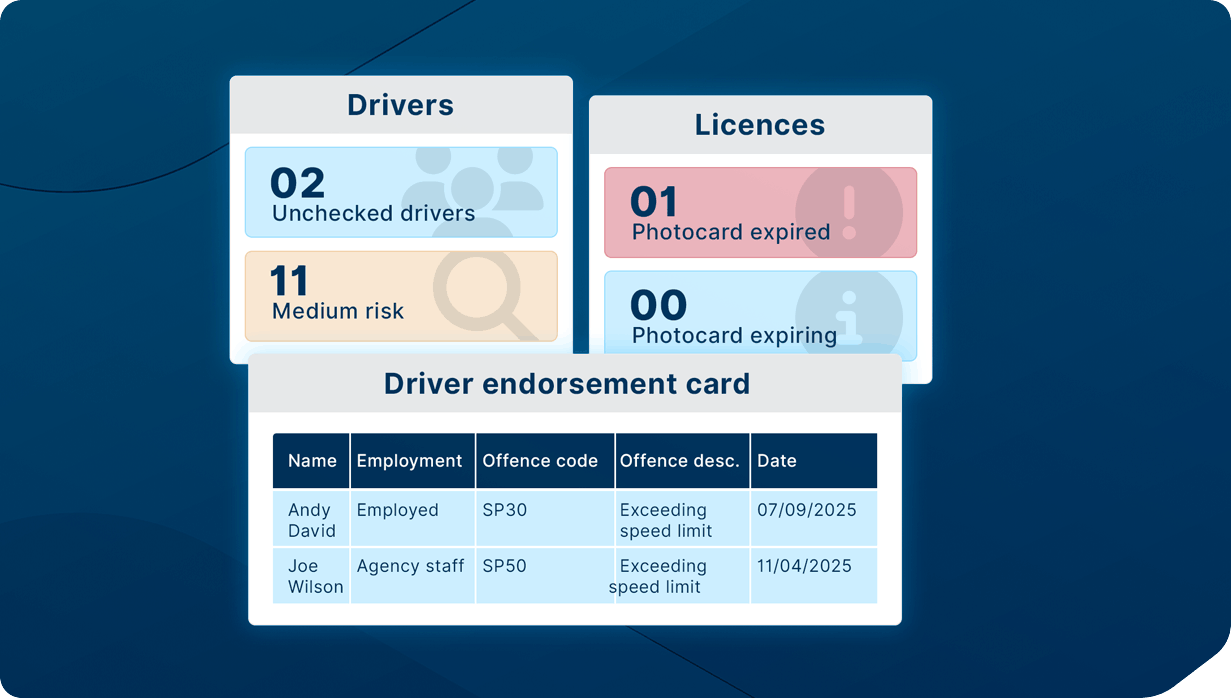
Technology has made this easier. A good system checks entitlement and endorsements against current DVLA data rather than a photocard that tells you nothing about today. It runs checks at a frequency that matches the driver's risk, not a flat interval applied to everyone. It reminds someone when a check is due, so nothing slips because it wasn't on anyone's calendar. It keeps a proper record of every check and what happened next, so there's something to show if anyone ever asks. It flags a driver as soon as something changes between scheduled checks, rather than waiting for the next one to catch it. And it sits alongside the rest of the driver risk picture.
Whether that's built in-house or bought in from a specialist provider is a separate decision. What matters is that whichever route is taken, the information stays current, the process is proportionate to the risk involved, and the whole thing would hold up if an insurer, auditor or investigator ever asked to see it.