







Managing the risk of young and novice van drivers: Driving culture from day 1
Published 08/09/26 | Read time 16 min

Managing the risk of young and novice van drivers: Driving culture from day 1
Published 08/09/26 | Read time 16 min
Summary
Managing the risk of young and novice van drivers means putting structured controls in place before they drive alone: a thorough vehicle induction, a permit-to-drive system, training delivered in short sessions over several weeks, and a mentor alongside them for the first few months. The young driver bracket runs from 17 to 24, which covers most apprentices and graduate trainees, so if your business hands van keys to anyone in their late teens or early twenties, this applies to you. Young drivers are involved in a disproportionate share of serious and fatal collisions on UK roads. That risk is foreseeable, which means it's also manageable. Employers applying the framework set out below have taken apprentice collision rates from three a month to zero.
TL;DR key takeaways
- You almost certainly employ young drivers. The 17–24 bracket includes most apprentices, graduate trainees and a large share of delivery drivers.
- The risk is measurable and severe; it falls hardest on young male drivers, who face four times the risk.
- The car-to-van transition is a separate risk from age, blind spots, handling, load dynamics and missing driver-assistance systems all catch out drivers who have been driving cars for years.
- Confidence grows faster than competence, and the gap between them is where most first-year incidents happen.
- Distributed training beats intensive training. The same content split into half-day sessions over four to six weeks, with mentoring alongside and no solo driving during it.
- The results are dramatic when it's done properly. One operator went from apprentices averaging three collisions a month to zero collisions across the following 11 months.
Introduction to young driver risk
When most people picture a “young driver” they picture a seventeen-year-old learner or someone who has just passed their test. It’s easy to file the whole issue as something for the DVSA or the insurance industry to worry about, rather than a workplace safety matter. But the young driver age bracket runs from 17 to 24, which means most apprentices, most graduate trainees and a substantial number of delivery drivers all sit inside it. If your business hands vehicle keys to anyone in their late teens or early twenties, you have young drivers on your fleet, and you are carrying the increased risk that comes with them.
That risk is real, foreseeable and considerable. Around one in five of all killed or seriously injured casualties on the road involve a driver aged 17 to 24. Young male drivers and the vast majority of van drivers are male who are four times more likely to be killed or seriously injured than the general driving population. And when we at Driving for Better Business (DfBB) started working with employers on this in 2024, the numbers coming out of individual businesses were startling. In one, apprentices were averaging three collisions per month. In another, a well-run fleet by any measure, the collision rate among young drivers was significantly higher than the rest of the workforce.
The good news is that those same employers have shown what works. This article distils the framework and the evidence from DfBB’s new guide, Managing Young, Novice and Inexperienced Van Drivers, which is available to download free from the Driving for Better Business website.
Why young drivers carry more risk
Three factors combine to elevate the risk for younger drivers.
Limited driving experience. According to the DVLA the average learner completes 45 hours of professional lessons and 22 hours of private practice before passing the practical test. But because there is no minimum requirement for on-road experience, two drivers holding identical licences can have very different levels of real-world driving experience. Intensive courses, can be especially risky, producing drivers who are ready for the test but lack short on practical road experience.
Neurological development. The prefrontal cortex – the part of the brain responsible for risk perception, decision making and emotional regulation – is not fully developed until the mid-to-late twenties. Younger drivers also have naturally later circadian rhythms, which creates additional fatigue risk when they are placed on early shift patterns.
Behavioural risk patterns. Elevated testosterone in young males has been linked to optimism bias about risk. Peer influence can normalise risky driving. Phone distraction is a documented factor in a disproportionate share of young driver collisions. And, perhaps most importantly for employers, risk-taking behaviour has been observed to increase as vehicle confidence grows.
The car-to-van transition is harder than it looks
Layered on top of these age-related factors is the challenge of moving from a car to a van. To anyone who has been doing it for years it looks like a simple step. It is not. A first-time van driver faces a set of specific challenges:
- Reduced forward and rear visibility with larger blind spots – and no interior rear-view mirror to rely on
- Restricted manoeuvrability, requiring more room for every turn and every reverse
- Different vehicle dynamics: heavier braking, a higher centre of gravity, greater sensitivity to crosswinds – and behaviour that changes again once the van is loaded
- Altered perception of speed from a more elevated driving position
- Different speed limits on roads the driver has experienced in a car for years
- Fewer advanced driver-assistance systems than a modern car – the safety features the driver has come to rely on as a safety net may simply not be present
The confidence-competence gap
There is one further dynamic that catches employers out. Confidence grows quickly, but competence takes considerably longer.
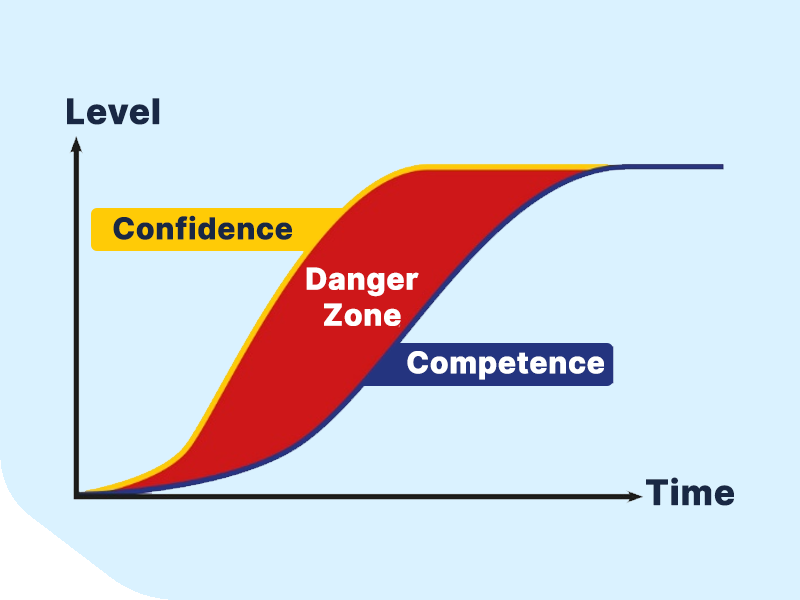
Danger zone behaviours:
- Over-estimate ability in challenging situations
- Take risks they’d avoid when truly competent
- Miss hazards specific to new vehicle
- Revert to habits from the old vehicle
- Higher speeds and closer following as confidence grows
A driver who has been in the van for a fortnight will often start to feel comfortable – “I’ve got the hang of this now.” But true competence with the ability to react correctly and immediately in any situation takes far longer to build. In the gap between the two, drivers become over-confident. They fail to identify risks properly. They start reverting to habits from their car. Speeds creep up and following distances shrink. Safety behaviours deteriorate even as mechanical handling skill improves. That gap is where most first-year incidents happen, and it is the single most important thing for any employer of young drivers to plan for.
A three-tier framework for managing the risk
Working with the employers who shaped our guide, an obvious pattern of good practice emerged, structured across three cumulative tiers.
| Tier | Focus | Key Components |
|---|---|---|
| Tier 1 | Minimum expected controls, for all new van drivers | Comprehensive vehicle induction; initial driver assessment and profiling; driving-for-work policy introduction or refresher; basic telematics monitoring |
| Tier 2 | Best practice, for all new van drivers | Permit-to-drive system; structured training programme covering knowledge, skills and standards; mentor or buddy system for a minimum of six weeks; regular coaching conversations grounded in telematics data |
| Tier 3 | Enhanced controls, specifically for under-25s | Extended training delivered on a distributed model; extended mentoring of up to six months with no solo driving; additional classroom and e-learning modules; targeted campaigns and regular refresher training |
The tiers are cumulative rather than alternatives. Tier 3 sits on top of Tier 2, which sits on top of Tier 1. An operator running Tier 3 arrangements for its under-25s is by definition also doing everything in Tier 1 and Tier 2 for those drivers.
A permit-to-drive is essentially an additional, company-specific licence with a higher threshold for obtaining it than a standard DVLA licence. Industry good practice includes a desktop risk assessment, a classroom induction workshop, at least two days of in-cab training, a pass-or-fail assessment, and eyesight testing. Entry requirements typically specify a full licence held for a defined minimum period and no serious convictions or excessive penalty points. Employers also need a documented process to revoke a permit, and require remedial training, if a driver’s standard drops.
Why distributed training outperforms intensive training
Of all the practices we have observed working, distributed training may be the most important – especially for younger drivers. Many companies still run a two-day intensive induction and then send new drivers out solo. The case studies show this approach doesn’t stand up, particularly for the under-25s. Distributed training splits the same content into a series of half-day sessions delivered over four to six weeks, and it produces markedly better outcomes because:
- Retention improves. Information moves from working memory to long-term memory between sessions
- Latent learning takes place. The brain consolidates skills subconsciously between sessions, often overnight
- Real-world application during the intervening days generates questions the driver can bring back to the next session
- Cognitive load stays manageable. The driver isn’t overloaded with training while learning a new job at the same time
- Repeated messaging lands. People typically need to hear a key message between three and seven times before it fully internalises
- Cultural commitment becomes visible. Ongoing support demonstrates the business is genuinely invested in the driver’s welfare rather than ticking an induction box
Mentoring runs alongside the distributed training. Mentors should themselves be consistently safe drivers, chosen for patience, teaching ability and willingness to challenge unsafe behaviour. Under our framework, mentoring runs for a minimum of six weeks for all new van drivers, and up to six months for under-25s, with no solo driving in that period. Given the current shortage of skilled drivers, being asked to mentor also acts as recognition and career development for the drivers you most want to keep.
Case Studies: What this looks like in practice
Both employer case studies in the guide illustrate what happens when the framework is applied properly.
| Business | Starting position | Intervention | Result |
|---|---|---|---|
| SP Electricity North West | Apprentices averaging three collisions per month | Four half-day distributed sessions; external experts brought in for classroom workshops on the most common causes, including phone distraction; scientific explanation of cognitive development; testimonials from parents of collision victims | Zero collisions across the following 11 months – an estimated 33 collisions prevented |
| Northern Powergrid | Significantly higher collision rate for young drivers than the rest of the workforce | Distributed training over six weeks with mentor pairing throughout; extended six-month mentorship for under-25s; permit-to-drive entry requirements (minimum two years' full licence, fewer than seven points, no drink, drug or phone convictions); mandatory slow-speed van manoeuvring course | Improved telematics scores across the whole fleet and a further reduction in collision frequency in an already well-run operation |
The message from both is the same. This is not complicated work. It is structured, patient, evidence-based work – and it delivers results that repay the investment many times over in reduced insurance premiums, lower repair costs, less lost time and, most importantly, drivers who go home safely at the end of each shift.
Five priority actions
If the framework feels like a lot to take on at once, five priority actions capture the essence of what makes it work:
- Implement a permit-to-drive system with clear entry requirements and a documented process to revoke the permit if standards are not met
- Provide comprehensive vehicle induction covering all controls, handling characteristics, ADAS limitations, how to conduct thorough pre-use vehicle checks and safe load management before any solo driving takes place
- Use distributed training structured as half-day sessions across four to six weeks rather than a two-day intensive
- Monitor behaviour and coach actively using telematics data as the foundation for coaching conversations, and reward improvement
- Establish a mentor or buddy system pairing new drivers with carefully selected mentors, extending up to six months for under-25s and with no solo driving during the mentorship period
Overcoming common objections
Every conversation with an employer at the start of this journey surfaces the same handful of objections. Each has a straightforward answer.
| Objection | The reality | What to do |
|---|---|---|
| "We don't have time for extended training" | Collision investigation claims management and vehicle downtime absorb significantly more time than training ever does. And distributed training uses the same total hours as a two-day intensive – it just spreads them out for better retention. | Reframe the trade-off. The question isn't "training or no training." It's "invest the time up front or spend more of it later dealing with incidents." |
| "Experienced drivers resist being treated like novices" | This often signals that the programme has been positioned as an age-based measure rather than a vehicle-based one, and that the underlying risks haven't been properly explained. | Position it as professional development and formal vehicle certification. It applies to every driver new to that vehicle type, regardless of age. |
| "We can't afford comprehensive monitoring" | Basic telematics is available from around £30 per vehicle per month. A single prevented collision typically covers the cost of monitoring a substantial portion of the fleet for a year. | Start with the highest-risk drivers, prove the return on investment, and expand from there. It doesn't have to be all-or-nothing on day one. |
| "Good mentors are too busy for mentoring duties" | If your best drivers are too stretched to develop the next generation, business resilience and safety culture will both suffer. | Build mentoring into job descriptions as a formal career progression step. Allocate protected time for it. Reward it properly, financially or through recognition. |
None of these objections is unreasonable in isolation. The trap is treating them as reasons not to act, rather than seeing the benefits they will bring as your system matures.
Keeping track of it all
There is one final piece that determines whether any of this truly works in practice: record keeping.
A three-tier framework for young driver management generates a lot of documentation. Permit-to-drive status for every eligible driver. Assessment outcomes and eyesight test dates. Progress through each stage of distributed training. Mentor allocations, mentorship start and end dates, and evidence that the no-solo-driving period was observed. Coaching notes tied to specific telematics events. Refresher training due dates. Incident records and the corrective action taken. Multiply all of this across a growing workforce and it becomes unmanageable on spreadsheets and memory alone.
The businesses that manage this well put the whole picture into a single fleet management system that flags what’s due, records what has been done, and produces an audit trail on demand. If the worst does happen, the difference between a defensible position and an indefensible one is not what was done, but whether there is evidence to show it was done. A well-designed system means that when an insurer, a Health and Safety Executive inspector, or in the very worst case a coroner asks what young driver risk management the business had in place, the answer is documented and evidenced.
Young and novice van driver FAQs
At what age is a driver considered a young driver?
The young driver bracket runs from 17 to 24. That's wider than most people assume and captures most apprentices, most graduate trainees and a substantial share of delivery drivers. If your business gives van keys to anyone in their late teens or early twenties, you have young drivers on your fleet and the elevated risk that comes with them.
Why are young drivers a higher risk behind the wheel?
Three factors combine. Limited real-world driving experience, since there's no minimum on-road requirement before passing the test. Neurological development, as the part of the brain governing risk perception and decision making isn't fully developed until the mid-to-late twenties. And behavioural patterns including optimism bias, peer influence and phone distraction.
Is driving a van harder than driving a car?
Yes, and more so than it looks. Vans have larger blind spots, no interior rear-view mirror, restricted manoeuvrability and different dynamics – heavier braking, a higher centre of gravity and greater crosswind sensitivity, all of which change again once loaded. Speed perception differs from a higher seating position, speed limits differ on the same roads, and vans typically have fewer driver-assistance systems than a modern car.
What is the confidence-competence gap?
It's the period where a driver feels comfortable in a new vehicle before they're genuinely competent in it. Confidence builds within a couple of weeks; competence – reacting correctly and immediately in any situation – takes far longer. In that gap drivers over-estimate their ability, speeds creep up and following distances shrink. Most first-year incidents happen there.
What is a permit to drive?
A permit to drive is a company-specific authorisation with a higher threshold than a standard DVLA licence. Good practice includes a desktop risk assessment, a classroom induction, at least two days of in-cab training, a pass-or-fail assessment and an eyesight test. Entry requirements typically specify a minimum period holding a full licence and no serious convictions or excessive penalty points. Employers also need a documented process to revoke a permit if standards slip.
What is distributed training, and why does it work better than an intensive course?
Distributed training splits the same content into half-day sessions across four to six weeks, rather than a two-day intensive. It uses the same total hours but produces better outcomes: retention improves between sessions, the brain consolidates skills subconsciously, real-world driving between sessions generates questions, cognitive load stays manageable, and key messages are repeated enough times to land.
How long should a new van driver be mentored?
A minimum of six weeks for any driver new to vans, extending up to six months for under-25s, with no solo driving during the mentorship period. Mentors should be consistently safe drivers chosen for patience, teaching ability and willingness to challenge unsafe behaviour, not simply the most senior person available.
Do these measures apply to experienced drivers who are new to vans?
Yes. The framework is vehicle-based, not age-based: comprehensive induction, a permit to drive, structured training and mentoring apply to every driver new to that vehicle type. Only the enhanced third tier with extended training and up to six months of mentoring is specific to under-25s. Framing it as vehicle certification rather than an age measure also removes most of the resistance from experienced drivers.
Author
-

Simon is a marketing and strategic communications specialist with 40 years experience, and has worked exclusively in the field of work-related road safety for 20 years.